Why Do Some Refugees Choose to Stay Even When Return Becomes Possible?
By Louay AL-Daher DAMI – Senter
06.08.2026
About this Research Series
This research series is part of DAMI Senter’s ongoing research programme on migration, asylum, and integration. It examines these issues from a legal and sociological perspective informed by contemporary international scholarship.
The series revisits the original philosophy of the international refugee protection regime established by the 1951 Convention Relating to the Status of Refugees. It explores how refugee protection has evolved over time, examining the relationship between temporary protection, durable solutions, refugee return, and local integration in light of contemporary political and social developments.
Rather than advocating a particular political position, the series seeks to provide an analytical framework for understanding the legal and social foundations of the international refugee protection system and the challenges it faces in the twenty-first century. Drawing on recent legal scholarship and migration research, it aims to promote a more evidence-based dialogue on one of the most debated issues in contemporary migration governance.
Introduction
The first two articles in this series examined the structural philosophy underpinning the international refugee protection regime as an emergency framework designed to respond to circumstances that may, by their nature, be temporary. They then considered the cessation provisions contained in Article 1C of the 1951 Refugee Convention, under which refugee status may come to an end when the circumstances that justified international protection have ceased to exist in a fundamental and durable manner. This legal analysis demonstrated that the Convention was not founded on the assumption that refugee protection must necessarily lead to permanent settlement in every case.
Yet even when major political and geopolitical transformations in the country of origin make return legally and practically conceivable, a more complex sociological and psychological question arises: why do some refugees choose to remain in their host countries?
If the political and security conditions that originally caused displacement have substantially changed, and if continued international protection is no longer considered necessary in the legal sense, why does return not occur automatically or on a comprehensive scale?
Answering this question requires moving beyond the relative rigidity of legal provisions and examining the sociological dynamics that shape individual behaviour. It also requires an understanding of how, over many years, a residence initially defined by the search for survival may gradually become organised around the pursuit of stability, predictability, and quality of life.
From Protection to Structural Stability
When refugees flee the devastation of war, their decisions are initially driven by the imperative of survival and the urgent search for safety. As displacement extends over many years, however, the structural function of residence in the host country gradually begins to change. What was initially understood as a temporary framework of protection against immediate danger becomes an organising structure for everyday life and a broader setting within which social and material stability is established.
Individuals learn the language of the host society, enter the labour market, enrol their children in stable educational systems, and gradually build a complex network of social relationships, institutional connections, daily routines, and practical interests. These accumulated forms of social and economic embeddedness alter the basis on which the possibility of return is subsequently evaluated.
A significant behavioural paradox emerges at this point: the more successful a host country is in facilitating structural integration and providing stable living conditions, the greater the practical costs associated with return may become. The institutions and opportunities that enable refugees to rebuild their lives during displacement may, over time, also deepen their reliance on forms of stability that cannot easily be reproduced in the country of origin.
The Integration Paradox and the Practical Calculus of Return
The study conducted by Kayaoglu, Şahin-Mencütek, and Erdoğan (2022) provides an empirical foundation for understanding this complex relationship. It demonstrates that aspirations to return are shaped not only by security conditions, political developments, and livelihood opportunities in the country of origin, but also by refugees’ economic, social, and cultural experiences in the host country. In the context examined by the study, perceived discrimination and sociocultural distance were particularly influential, illustrating that integration may affect return aspirations through multiple and sometimes contradictory mechanisms.
The authors describe this relationship as an “integration paradox.” Integration does not operate in a single direction. Limited inclusion, discrimination, and perceived social distance may strengthen the desire to leave the host country. Conversely, secure livelihoods, institutional familiarity, and accumulated social attachments may increase the practical costs associated with return. The successful construction of a stable life during displacement may therefore, under certain circumstances, reduce aspirations to return rather than reinforce them.
At this stage, individuals are no longer comparing danger with safety alone. Instead, they are comparing two distinct life trajectories: one grounded in established routines, access to functioning institutions, and the ability to plan for the future; the other requiring them to relinquish accumulated forms of stability and rebuild their lives under potentially more uncertain conditions.
Return consequently becomes more complex than a direct response to the end of war or the disappearance of immediate fear. It involves a broader reassessment of livelihoods, children’s education, family welfare, social networks, institutional security, and future prospects.
Formal Citizenship and Lived Belonging
This brings us to one of the most complex sociological questions within refugee and migrant communities: the potential gap between formal citizenship and lived belonging.
Over time, a refugee or migrant may obtain permanent residence and, eventually, citizenship in the host country. Citizenship grants the individual full legal, political, and social membership in the state. In formal terms, the naturalised citizen becomes a full member of the political community, entitled to the same legal protection and fundamental rights as other citizens.
Legal and institutional incorporation, however, does not necessarily produce an equivalent transformation in identity or belonging. In many cases, individuals retain strong symbolic, cultural, and emotional ties to their countries of origin even after acquiring citizenship in the host country.
A complex distinction consequently emerges between citizenship as a formal legal status and belonging as a deeper emotional, cultural, and historical experience. An individual may participate in the political life of the host country, rely on its institutions and services, and exercise the rights associated with citizenship, while simultaneously remaining emotionally and culturally attached to the country of origin. The same individual may continue to follow its political developments, celebrate moments of national transformation, and understand part of their identity through the history and collective memory of that society.
These forms of attachment do not necessarily indicate an absence or failure of integration. Rather, they demonstrate that citizenship and belonging operate at different analytical levels. A passport or secure legal status may formalise membership in a political community, but it cannot, by itself, determine the individual’s historical memory, cultural identification, or emotional sense of home.
The Erosion of Social Ties and the Crisis of Political Trust
Alongside the stability provided by host countries, other factors may reduce both the feasibility and the perceived sustainability of return. Research by Dinçer and Şahin-Mencütek (2025) indicates that return and reintegration are shaped not only by present conditions in the country of origin, but also by expectations concerning the durability of political change and the capacity of emerging institutions to provide security, representation, and protection over time.
A refugee who has spent many years within a comparatively stable institutional environment does not evaluate the present situation alone. The decision also involves an assessment of what may happen in the months and years ahead. Doubts about the sustainability of political change, the inclusiveness of new governing structures, or the capacity of public institutions to protect rights may therefore become powerful factors in favour of remaining in the host country.
In a related context, Narmanlıoğlu and Bayrakcı (2026) examine the transnational communication networks connecting Syrian refugees with their communities of origin. Their research demonstrates how prolonged separation, deep-seated social and sectarian divisions, fear of surveillance, pervasive mistrust, and chronic infrastructure failures may weaken or sever what is commonly described as “bonding social capital”: the dense networks of family and community relationships through which individuals maintain practical and emotional connections to their society of origin.
When these ties deteriorate, return is no longer a matter of physical relocation alone. Social networks frequently provide access to information, accommodation, employment, protection, and the practical resources required for reintegration. Their erosion may therefore leave potential returnees socially unprepared, even when political transformation appears to have removed some of the original causes of displacement.
After many years abroad, some refugees may consequently discover that they are not returning to the same society they once left. The country has changed, its social structures have been transformed, and the refugees themselves have also changed through their experiences of displacement and integration. At this point, the homeland may remain powerfully present in memory and emotional identification while becoming less present in the relationships, routines, and practical networks of everyday life.
Between Stability and Belonging
Contemporary research demonstrates that the decision to remain in a host country cannot be reduced either to continuing fear or to access to social assistance. Nor can it be explained solely by integration, economic success, or the pursuit of improved living standards.
The reality is considerably more complex. The decision emerges from an interaction between material and institutional stability, growing reliance on the systems of the host country, newly established social relationships, confidence in the future, continuing emotional attachment to the country of origin, and the cumulative experiences through which individuals and families have rebuilt their lives during displacement.
These factors do not necessarily point in the same direction. Emotional attachment and collective memory may strengthen the desire to return, while institutional reliance, family considerations, educational continuity, and uncertainty about the future may simultaneously reinforce the decision to remain. Refugees may therefore experience belonging to the country of origin and practical dependence on the host country not as mutually exclusive conditions, but as parallel realities shaping the same decision.
For this reason, the disappearance of the legal grounds for refugee protection does not automatically remove the social, familial, and institutional factors that influence return. The law may determine that international protection is no longer required, but it cannot reverse the life-course transformations produced by prolonged displacement. Ending the legal necessity for protection and making return socially viable are therefore closely related, but analytically distinct, questions.
Conclusion
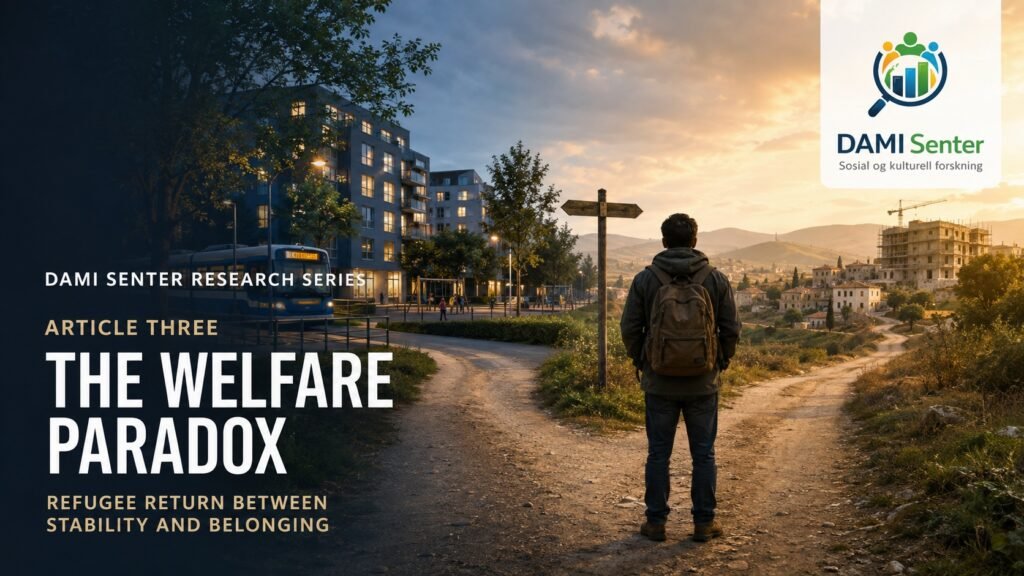
The “welfare paradox” helps explain why the disappearance of the political and security conditions that originally caused displacement does not necessarily produce an automatic or comprehensive return. While the law evaluates the continuing need for protection through defined legal criteria, individuals approach return through a more complex calculus involving institutional stability, family life, education, employment, social relationships, belonging, and expectations of the future.
As displacement becomes prolonged and reliance on the institutions of the host country increases, return becomes more than a reversal of the original journey of flight. It may require individuals and families to reorganise an entire life course constructed over many years. This does not negate the legal possibility of ending refugee protection, nor does it imply that such protection must become permanent. It does, however, demonstrate the distance that may emerge between the legal possibility of return and its social and personal feasibility.
One of the most striking paradoxes of contemporary refugee protection consequently becomes visible: host countries that are most successful in providing security, institutional stability, and opportunities for integration may also face some of the most persistent challenges in relation to return. The same structures that enable refugees to rebuild their lives during displacement may substantially increase the personal, familial, and material costs of leaving.
The central question therefore remains open:
If return is no longer solely a legal question but has become a complex social, ethical, and personal decision, where does individual freedom to choose one’s place of residence end, and where does the responsibility to contribute to the reconstruction of war-torn countries begin?
Next Article in the Series
Article Four: Individual Freedom of Choice or a Responsibility to Contribute to Reconstruction?
The next article moves from explaining the motivations for remaining in the host country to examining the ethical dimension of return. It asks whether return should remain an exclusively personal choice or whether a moral and civic responsibility arises when return becomes genuinely possible. Can individuals be said to have an obligation towards their society of origin once the original grounds for refugee protection have ceased to exist, or should personal freedom to determine where and how to live remain the overriding principle?
References
Dinçer, O. B., & Şahin-Mencütek, Z. (2025). Refugee return, reintegration, and citizenship practices in post-conflict Syria. International Migration, 63(1), e13379. https://doi.org/10.1111/imig.13379
Kayaoglu, A., Şahin-Mencütek, Z., & Erdoğan, M. M. (2022). Return aspirations of Syrian refugees in Turkey. Journal of Immigrant & Refugee Studies, 20(4), 561–583. https://doi.org/10.1080/15562948.2021.1955172
Narmanlıoğlu, H., & Bayrakcı, S. (2026). Disconnected and alone: Communication barriers of Syrian refugees in return and reintegration. Middle East Journal of Culture and Communication, 19(1), 26–46. https://doi.org/10.1163/18739865-bja10011
United Nations. (1951). Convention relating to the status of refugees. United Nations Treaty Series, 189, 137. https://www.unhcr.org/media/convention-and-protocol-relating-status-refugees