What Makes the Sea Look More Rational Than Staying?
Morocco and the 2026 Ceuta Crisis
DAMI Senter – Working Paper No. 04/2026
11.08.2026
By Louay AL-Daher
A country does not need to be at war for its young people to want to leave.
Institutions may still function. Streets may be safe. Development may be visible. Schools may remain open, businesses may operate, and the state may appear stable.
And yet, thousands of young people may still come to believe that their most credible future lies somewhere else.
This is the paradox at the heart of the new DAMI Senter Working Paper No. 04/2026, which examines Morocco and the 2026 Ceuta crisis as a revealing case of a much broader question:
What happens when a country remains stable, but staying no longer feels like a convincing investment in the future?
The paper challenges one of the most common explanations of irregular migration: that people leave mainly because they are poor, unemployed, or escaping crisis.
Those factors matter.
But they are not enough.
The study distinguishes between two questions that are often confused:
Why does someone want to leave in the first place?
And:
Why does that desire suddenly turn into action at a particular moment?
A court ruling, a rumour, a viral video, a temporary change at the border, or the visible success of those who crossed first may help explain why a migration surge happens now.
But these factors cannot fully explain why so many people were already prepared to respond to such an opportunity.
The paper puts it simply:
The spark may explain the moment of ignition, but it does not explain why the fuel was already there.
The evidence suggests that the “fuel” begins much earlier.
According to the latest labour-market data used in the study, the narrowly defined unemployment rate among Moroccans aged 15–24 reached 27.2% in the second quarter of 2026, while the composite rate of labour underutilization stood at 41.7%.
But an equally important finding comes from before the Ceuta crisis.
Arab Barometer data showed that 55% of Moroccans aged 18–29 reported that they had previously considered emigrating, compared with 24% among those aged 30 and above.
This does not mean that 55% intended to migrate, nor that they were willing to cross a border irregularly.
It does mean something else:
the idea of leaving was already deeply present before the border crisis began.
The working paper therefore goes beyond unemployment and poverty. It examines job quality, the expected return on education, delayed independence, the time required to build an adult life, dignity, agency, social mobility, migration networks, social comparison, and the images of life abroad circulating through families and digital spaces.
At the centre of the analysis is a concept proposed by the study:
The Possible-Life Gap
The Possible-Life Gap describes:
the perceived distance between the life a person aspires to build and the life they believe local economic, social, and institutional conditions realistically allow them to achieve within a reasonable period of time.
This shifts the migration question.
The issue is no longer simply:
How poor is this young person today?
It becomes:
What does this young person believe their life will look like five or ten years from now if they stay?
A person may tolerate difficulty if they believe it is temporary.
They may accept a low-paid first job if they believe it leads somewhere.
They may postpone independence if they believe the delay has an end.
But when waiting stops looking like a stage and starts looking like a permanent condition, the meaning of staying changes.
The question becomes brutally simple:
If I stay here, where will the next years of my life actually take me?
The paper also challenges another assumption: that education and development automatically reduce migration aspirations.
They may not.
Education increases capabilities, but it can also increase expectations about employment, income, independence, recognition, and social status.
Development can raise what people believe is possible before local institutions are able to provide the paths needed to achieve it.
In other words:
aspirations can move faster than opportunities.
When this happens, development does not necessarily close the migration gap.
It may expose it.
The study then turns to one of the least discussed forces shaping migration aspirations: the migrant who has already left.
Migrants do not send home money alone.
They also send images.
Cars. Apartments. Holidays. Restaurants. New clothes. Travel. Consumption. A different rhythm of life.
The long working hours, debt, housing costs, professional downgrading, loneliness, or insecurity abroad may be much less visible.
When the “successful migrant” is not a celebrity but a cousin, neighbour, former classmate, or childhood friend, the comparison becomes far more powerful.
The paper therefore proposes another testable hypothesis:
The Demonstration Effect of Migration Success
Visible success by a socially close migrant may function as evidence that migration is not merely possible for “other people”, but potentially reproducible by someone like me.
The message is no longer:
People succeed abroad.
It becomes:
Someone like me succeeded abroad. Why should I stay?
The paper treats this as a hypothesis requiring further empirical testing, not as a proven national causal effect.
It also addresses perhaps the most disturbing question of all:
Why would someone risk drowning in order to leave a country that is not at war?
The study does not claim that crossing the sea is objectively rational.
Instead, it argues that risk cannot be understood independently of the alternative.
If a person believes that staying offers a credible path toward work, independence, mobility, and a meaningful future, the cost of risking that path may be very high.
But if staying is perceived as years of repetition, waiting, dependency, or blocked mobility, the calculation may change.
The sea does not become less dangerous. What changes is the perceived relationship between the danger of leaving and the value of staying.
The 2026 Ceuta crisis then allows the paper to examine how long-term migration thinking can suddenly become collective action.
For this purpose, the study proposes a second analytical model:
Readiness – Opportunity – Cascade
Readiness: Pre-existing migration thinking or aspirations make departure imaginable.
Opportunity: A real or perceived change makes action appear temporarily more feasible.
Cascade: Information spreads rapidly, early attempts become visible, and the behaviour of others can lower the threshold for additional people to act.
The model helps explain why neither unemployment nor a court ruling can explain the crisis alone.
Structural frustration may explain why people were prepared to leave.
A temporary opportunity may explain why they moved at that moment.
And a social cascade may help explain why individual decisions became a mass movement.
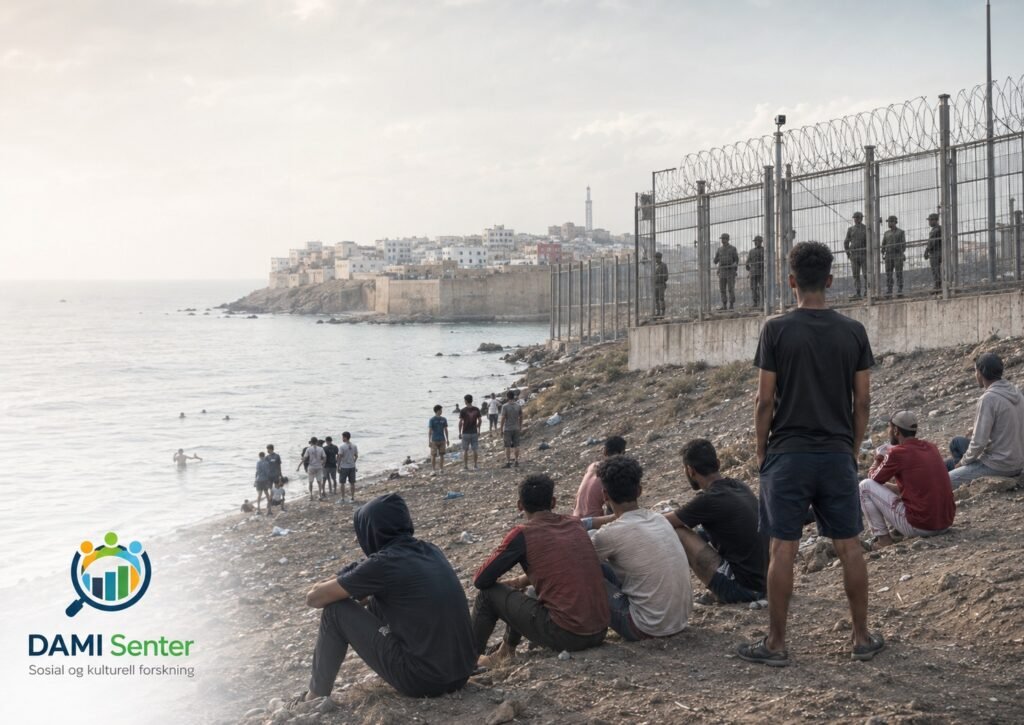
This is why the Ceuta crisis should not be understood only as a border crisis.
It raises a more uncomfortable question:
What happens before young people reach the border that makes the future beyond it appear more credible than the future within it?
The paper ultimately argues that a state’s ability to control migration should not be confused with its ability to preserve the attractiveness of staying.
A border can be closed.
A route can be blocked.
A rumour can be corrected.
A boat can be stopped.
But none of these actions necessarily answers the deeper question:
Why did leaving become so attractive in the first place?
For this reason, the study proposes moving beyond migration policy alone toward what it calls a broader “future policy” perspective: asking whether education, employment, housing, independence, social mobility, and trust in institutions create a local pathway that young people can realistically believe in.
Because migration does not always begin at the border.
Sometimes it begins years earlier.
Borders explain where people left from; they do not explain why they wanted to leave.
And the working paper ends with its central warning:
“The real danger does not begin when young people reach the shore; it begins years earlier, when they stop imagining their future within their own country.”
DAMI Senter – Working Paper No. 04/2026
11.08.2026
Louay AL-Daher
Interested in the full working paper?
Contact DAMI Senter to request the complete version.