Article 1 Asylum Between Temporary Protection and Durable Solutions
The Refugee Dilemma: Temporary Protection and the Responsibility of Return
DAMI Senter Research Series
By Louay AL-Daher
15.07.2026
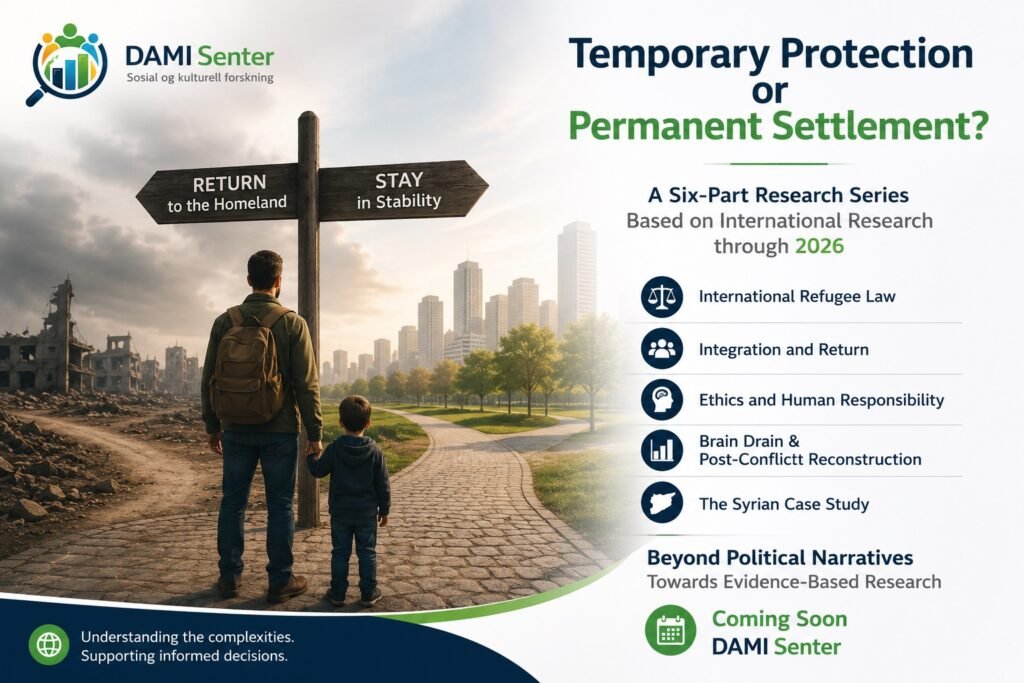
About this Research Series
This research series is part of DAMI Senter’s ongoing research programme on migration, asylum, and integration. It examines these issues from a legal and sociological perspective informed by contemporary international scholarship.
The series revisits the original philosophy of the international refugee protection regime established by the 1951 Convention Relating to the Status of Refugees. It explores how refugee protection has evolved over time, examining the relationship between temporary protection, durable solutions, refugee return, and local integration in light of contemporary political and social developments.
Rather than advocating a particular political position, the series seeks to provide an analytical framework for understanding the legal and social foundations of the international refugee protection system and the challenges it faces in the twenty-first century. Drawing on recent legal scholarship and migration research, it aims to promote a more evidence-based dialogue on one of the most debated issues in contemporary migration governance.
Article 1
Asylum Between Temporary Protection and Durable Solutions
What Did the 1951 Refugee Convention Really Intend?
Revisiting the Legal and Historical Foundations of the International Refugee Protection Regime
Introduction
Few concepts in international law have generated as much political controversy as asylum. Across Europe and beyond, debates surrounding refugee protection have become increasingly intertwined with questions of migration management, national identity, border control, social cohesion, and the sustainability of welfare systems. While public discussions often focus on immediate political concerns, they frequently overlook a fundamental question that lies at the heart of the international refugee regime:
What was the original purpose of asylum?
Was the international refugee protection system conceived as a temporary humanitarian response for individuals who had lost the protection of their own states? Or was it intended from its inception to provide a permanent pathway to settlement in a host country?
These questions are particularly significant because many contemporary policy debates implicitly rest on assumptions that are rarely examined against the legal foundations of the refugee regime. As a result, political narratives frequently take precedence over historical and legal analysis.
This article returns to the origins of the 1951 Convention Relating to the Status of Refugees to examine its underlying philosophy through contemporary legal scholarship. Rather than engaging with contemporary political controversies, it explores how the Convention originally conceptualised refugee protection, the structural role of temporary protection, and the relationship between refugee status and the pursuit of durable solutions.
The Birth of the International Refugee Protection Regime
The modern international refugee protection system emerged from the unprecedented humanitarian devastation of the Second World War. Millions of Europeans had been displaced by war, persecution, occupation, and radical political transformation, leaving countless individuals unable—or unwilling—to return to their countries of origin.
Against this backdrop, the 1951 Refugee Convention was drafted not as an alternative immigration framework, but as a legal mechanism designed to protect individuals who had effectively lost the protection of their own states. Its primary objective was therefore humanitarian protection rather than permanent migration.
This philosophy is reflected in one of the most influential concepts within international refugee law: surrogate protection. Under this principle, the international community temporarily assumes the protective role normally exercised by the refugee’s country of nationality whenever that state becomes unable or unwilling to guarantee fundamental rights and security.
Recent scholarship reinforces this interpretation. Ziegler (2026) argues that international refugee law is fundamentally built upon the Right to Remain—the principle that individuals should, wherever possible, be able to live safely within their own countries. Forced displacement is therefore understood not as a desirable outcome, but as an exceptional consequence of armed conflict, persecution, or state failure.
From this perspective, asylum is not conceived as a substitute for citizenship or one’s homeland. Rather, it functions as an extraordinary legal response to extraordinary circumstances.
Buxton (2023) reaches a similar conclusion, emphasising that refugee status under the 1951 Refugee Convention is inherently linked to the absence of effective national protection. The Convention itself recognises that refugee status is not necessarily permanent and provides explicit legal mechanisms—most notably, the cessation clauses—through which protection may cease once the circumstances giving rise to refugeehood no longer exist or once effective alternative protection has been secured through other legal means.
Consequently, the Convention did not establish asylum as a permanent alternative to nationality. Instead, it created an international protection regime intended to respond to exceptional situations until a durable legal solution could eventually be achieved.
Temporary Protection: Flexibility in Response to Mass Displacement
Although the 1951 Refugee Convention remains the cornerstone of international refugee law, contemporary displacement crises have exposed structural challenges that its original drafters could scarcely have anticipated. Large-scale refugee movements resulting from civil wars and regional conflicts frequently overwhelm standard asylum procedures, rendering individual Refugee Status Determination (RSD) both administratively demanding and politically sensitive.
In response, many states have developed temporary protection regimes as complementary mechanisms to conventional RSD procedures.
As Öztürk (2025) explains, temporary protection emerged primarily as a pragmatic legal instrument capable of responding rapidly to mass influxes in which processing individual asylum applications within a reasonable timeframe became practically impossible.
Importantly, temporary protection did not replace the 1951 Refugee Convention. Instead, it evolved alongside it, offering states greater procedural flexibility while continuing to provide immediate international protection for displaced populations.
The relationship between temporary protection and the Refugee Convention, however, has never been entirely uniform. Domestic legal frameworks differ considerably, resulting in significant variations regarding legal and
socioeconomic rights, the duration of protection, access to labour markets, social welfare, and long-term legal certainty.
Despite these institutional differences, contemporary legal scholarship identifies one common underlying principle: temporariness.
Temporary protection was never intended to represent a permanent legal status. Rather, it rested on the operational expectation that the extraordinary conditions driving mass displacement would eventually subside, enabling governments and international organisations to pursue sustainable long-term solutions.
From this analytical standpoint, temporariness should not be understood merely as an administrative label. Rather, it represents one of the foundational structural principles of international refugee protection: exceptional humanitarian crises require immediate protection, but they do not necessarily justify permanent legal displacement from an individual’s country of origin.
The Three Durable Solutions: Balancing Protection and Long-Term Stability
Contrary to a common misconception in public debate, the international refugee regime has never regarded refugee return as the sole legitimate outcome of displacement. Instead, the United Nations High Commissioner for Refugees (UNHCR) has long recognised three durable solutions capable of ending refugee situations: voluntary repatriation, local integration in the country of asylum, and resettlement in a third country.
These three pathways reflect different legal, political, and humanitarian realities rather than a single universal model applicable to every refugee situation.
Nevertheless, recent scholarship highlights what Davis and Ayanlowo (2025) describe as a preference imbalance within the international protection system. While all three solutions are formally recognised as legitimate, voluntary repatriation has historically remained the solution most closely aligned with the original philosophy of the 1951 Refugee Convention—provided that return is voluntary, safe, dignified, and sustainable.
This institutional preference does not stem from a legal obligation requiring refugees to return under all circumstances. Rather, it reflects the underlying assumption that international protection exists because national protection has temporarily failed. Once genuine protection can again be provided by the country of origin, restoring the legal relationship between individuals and their own societies becomes an important objective of the international protection system.
By contrast, local integration and third-country resettlement often involve broader political considerations extending beyond refugee law itself. Questions concerning immigration policy, public resources, social cohesion, national identity, labour market participation, and public acceptance frequently shape governments’ willingness to adopt these solutions on a larger scale.
At the same time, legal scholars caution against a reductive understanding of return. As Stoyanova (2022) argues, the legal cessation of refugee status cannot depend solely upon political developments or the formal end of armed conflict. What ultimately matters is whether individuals can genuinely benefit from effective national protection upon return. Consequently, determining when international protection should cease requires a careful, individualised legal assessment rather than political assumption.
The existence of three recognised durable solutions therefore illustrates one of the defining features of the international refugee regime: while refugee protection may begin as an emergency humanitarian response, its ultimate objective has always been to identify a stable, lawful, and sustainable solution capable of restoring long-term legal security for displaced individuals.
From Temporary Protection to Protracted Refugee Situations
While the original philosophy of the international refugee regime envisioned displacement as a temporary condition followed by one of the recognised durable solutions, contemporary reality has evolved in a markedly different direction. Across many regions of the world, refugee situations now persist not for months or a few years, but for decades.
This phenomenon—commonly referred to as protracted refugee situations—has become one of the defining challenges of modern refugee protection.
As refugee crises have become increasingly prolonged, the distinction between temporary protection and long-term residence has gradually blurred. Millions of refugees now spend significant portions of their lives in host countries without reaching any of the durable solutions originally envisaged by the international protection system.
Buxton (2023) argues that this prolonged state of legal limbo may itself become a source of injustice. Rather than providing temporary security followed by a durable outcome, extended protection can leave individuals suspended between legal categories, unable either to rebuild their lives fully in the host country or to return safely to their countries of origin. This condition creates what Buxton describes as compounding injustice, whereby legal and social
uncertainty accumulates over time and generates new forms of vulnerability beyond the original causes of displacement.
These developments have prompted renewed debate among legal scholars regarding the temporal boundaries of international protection. If refugee status is intended to respond to exceptional circumstances, at what point does temporary protection effectively become permanent in practice?
The question is not merely administrative. It touches the very foundations of the refugee regime established after the Second World War. The 1951 Refugee Convention was drafted on the assumption that protection would eventually be followed by a durable legal outcome. Yet contemporary geopolitical realities—including protracted armed conflicts, fragile peace processes, recurring violence, and political instability—have challenged that assumption in ways the Convention’s drafters could scarcely have anticipated.
As a result, contemporary refugee law now operates within an inherent tension. On the one hand, the legal framework continues to define refugee protection as an exceptional response to the absence of national protection. On the other hand, the persistence of long-term displacement has increasingly transformed temporary protection into an extended social reality for millions of refugees worldwide.
Understanding this tension is essential for interpreting contemporary debates on refugee return, integration, and the future of international protection. It demonstrates that many of today’s legal and political controversies do not arise because the underlying legal principles have fundamentally changed, but because the duration and complexity of modern displacement increasingly exceed the assumptions upon which those principles were originally constructed.
Conclusion
A careful examination of the legal and historical foundations of the international refugee regime reveals that the 1951 Refugee Convention was not conceived as a permanent alternative to citizenship or as a parallel pathway for international migration. Rather, it established a legal framework designed to provide international protection to individuals who had temporarily lost the protection of their own states.
At the same time, the international refugee system has consistently recognised three legitimate durable solutions: voluntary repatriation, local integration, and third-country resettlement. Although none of these solutions is legally superior in every circumstance, voluntary repatriation has historically remained
the outcome most closely aligned with the Convention’s original philosophy, provided that return can be undertaken voluntarily and under conditions that are safe, dignified, and sustainable.
However, the emergence of protracted refugee situations has fundamentally complicated the practical application of this framework. Long-term displacement has exposed a widening gap between the Convention’s original assumptions and the realities of contemporary refugee crises, raising profound legal and ethical dilemmas concerning the duration of protection and the conditions under which refugee status should eventually come to an end.
These dilemmas lead directly to one of the most contested questions in contemporary refugee law:
When can it legitimately be concluded that the circumstances justifying international protection have genuinely ceased to exist?
Who possesses the legal authority to make that determination?
Is the end of armed conflict or political change alone sufficient to terminate refugee status, or must effective national protection also be demonstrably restored?
These questions lie at the heart of the Convention’s cessation clauses and continue to shape legal and political debates across Europe and beyond. They form the subject of the next article in this research series.
Next Article
Article 2
When Does a Refugee Cease to Be a Refugee?
Article 1C of the 1951 Refugee Convention Between Changed Circumstances and Political Reality
If refugee protection was originally conceived as a temporary legal response to exceptional circumstances, an equally important question follows:
When should that protection legally come to an end?
The next article examines Article 1C of the 1951 Refugee Convention, which defines the legal circumstances under which refugee status may cease. It explores the concept of “ceased circumstances”, the relationship between legal standards and political decision-making, and one of the most debated questions in contemporary refugee law:
Is the end of war or the collapse of a political regime sufficient to justify the termination of refugee protection, or must effective and durable national protection first be restored?
References
Buxton, R. (2023). Refugee Protection and the Ethics of Protracted Displacement.
Davis, M., & Ayanlowo, T. (2025). Durable Solutions and Preference Imbalance in International Refugee Protection.
Öztürk, M. (2025). Temporary Protection Regimes in Comparative Refugee Law.
Stoyanova, V. (2022). The Cessation of Refugee Status and Effective National Protection.
Ziegler, R. (2026). The Right to Remain and the Foundations of International Refugee Law.
Copyright
©2026 DAMI Senter. All rights reserved.
This article is part of the DAMI Senter Research Series.
No part of this publication may be reproduced, distributed, or republished, in whole or in part, without prior written permission from DAMI Senter. Proper acknowledgment of the original source is required for any authorised citation or academic reference.
The views expressed in this article are those of the author and do not necessarily represent the official position of DAMI Senter.