Engineering Pathways: Toward a DAMI Model of Social Interaction
From Margins to Pathways: Deconstructing Delinquency, Identity, and Integration among Migrant Youth in Europe
Season One: From Victim to Actor – Deconstructing the Myth of Absolute Innocence
Episode Six (Final Episode)
By Louay AL-Daher DAMI Senter
07.07.2026
Series Framework
This article is part of the analytical series From Margins to Pathways: Deconstructing Delinquency, Identity, and Integration among Migrant Youth in Europe. The series seeks to deconstruct the complex relationship between migration, identity, marginalization, and delinquency through a sociological perspective that moves beyond reductionist explanations and attempts to understand how youth trajectories are shaped between resilience and deviance within contemporary European societies.
The Intellectual Opening
After five consecutive episodes examining the myth of material deprivation, the resilience paradox, the mechanisms of alternative street culture, apologetic academic traps, and the complex dynamics of the offender–victim overlap, we finally arrive at the question that has remained silently present behind all of these theoretical confrontations:
If material deprivation alone, traumatic experiences alone, cultural background alone, or absolute individual will alone be insufficient to explain pathways of delinquency and deviance, then where does an individual’s final trajectory within the contemporary European margin actually emerge?
The problem is that traditional social sciences have spent decades searching for a single actor responsible for producing crime and deviance. At one point responsibility was entirely assigned to the family; at another, to schools, poverty, vulnerable neighborhoods, or migrant cultural backgrounds, as if human beings operated inside a simple mechanical system controlled by a single switch.
However, the social reality deconstructed throughout this season reveals a profoundly different picture.
Human beings do not develop within isolated and disconnected causes. Rather, they move through an interconnected network of pressures, opportunities, constraints, relationships, and choices that continuously interact with one
another. Consequently, the final social trajectory becomes the outcome of a much more complex movement than the influence of any isolated factor.
It is precisely within this analytical gap that DAMI proposes its alternative explanatory model.
Structural Analysis
Bringing together the analytical threads developed throughout this season reveals that the problem has never been a lack of data or insufficient research. Rather, the challenge lies in the interpretative frameworks through which this data has been understood.
Statistics Norway (SSB) demonstrates that disparities associated with delinquency and high-risk behaviors decline significantly when economic conditions, social variables, and labor-market factors are incorporated into analytical models. This substantially weakens cultural-essentialist perspectives that assume fixed characteristics associated with migrant backgrounds themselves.
Simultaneously, research by Hermansen (2023) and findings from Ung i Oslo (2023) demonstrate that vulnerable urban environments do not produce identical outcomes among all individuals living within them.
The same neighborhood, the same school system, and occasionally even the same family structure can simultaneously generate sharply divergent trajectories of severe deviance and remarkable resilience.
However, the primary limitation of certain conventional approaches did not originate from their statistical findings themselves. Rather, it emerged from their tendency to isolate risk factors from their broader interactional contexts, transforming probabilistic indicators into closed explanatory systems.
Relative deprivation, social stigma, structural pressures, and exposure to trauma do not function as automatic mechanisms producing crime. Instead, they operate as pressure components within a significantly more complex interactional network.
Interactive Deconstruction
From this point, DAMI moves beyond the traditional question that has dominated social sciences for decades:
Why did this individual deviate?
Toward a fundamentally different question:
How was this pathway constructed?
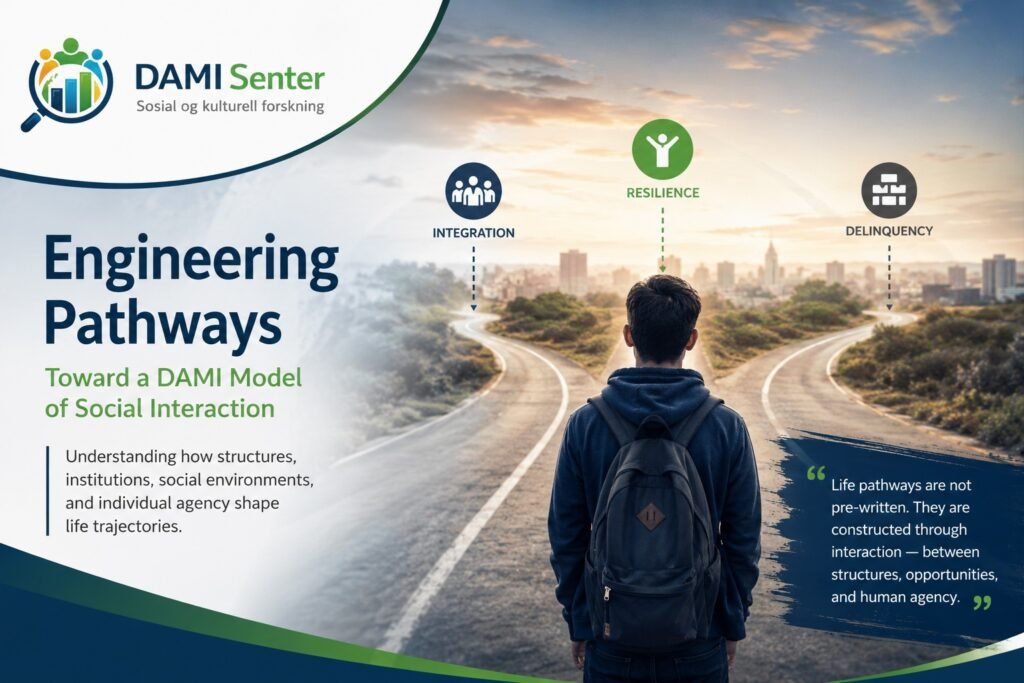
The DAMI model assumes that an individual’s final social trajectory does not emerge from the simple accumulation of isolated factors. Instead, it results from a continuous dialectical interaction among interconnected components that constantly influence one another.
Structural pressures generated through relative deprivation, stigma, and exclusion do not function as predetermined destinies. Rather, they establish pressure environments capable of generating alienation and motivating searches for alternative sources of recognition.
Simultaneously, protective and integrative factors—including cohesive family structures, institutional attachment to schools, and effective social networks—operate as institutional brakes capable of limiting this drift.
Within environments where these protective structures weaken, alternative markets of recognition emerge, represented through street subcultures and peer networks that provide immediate identities, rapid status, and influence constructed through dominance and fear.
Yet one decisive element remains irreducible within this entire interactional process:
Bounded Agency.
Individuals neither function as fully programmed machines nor as completely unrestricted actors. Instead, they exercise decisions within the limits established by available opportunities and structural pressures.
Consequently, final pathways—whether directed toward resilience, upward integration, delinquency, or downward assimilation—become outcomes of both interactional quality and the effectiveness of individual decision-making within these structural environments.
At this point, innocent apologetics collapse.
So does cultural demonization.
Sovereign Conclusion
Early delinquency within vulnerable European margins is not the product of material poverty alone, isolated trauma, cultural heritage, or any single explanatory variable.
Rather, it emerges from a complex social architecture in which institutions and individuals simultaneously carry reciprocal responsibilities within a shared structure.
Welfare systems fail when they limit themselves to managing material symptoms while neglecting symbolic deprivation and the production of meaning and belonging.
Families fail when their capacity for regulation and guidance weakens.
Schools fail when they transform from institutions of integration into environments capable of reproducing alienation and disengagement.
Yet individuals themselves also carry responsibility when, within their bounded agency, they adopt strategies designed to bypass the social contract in pursuit of immediate recognition and alternative influence.
Perhaps the most uncomfortable conclusion of this first season is not that human beings live under social structures that shape them.
It is that human beings actively participate in reproducing these structures themselves.
Individuals either reinforce the rule of law and the social contract through responsibility and resilience—or contribute to reproducing marginalization and crime through alternative markets of influence and dominance.
Perhaps this is precisely where DAMI begins asking its own distinct question:
The problem is not identifying whom to blame. The problem is understanding how pathways themselves are constructed.
Next Article
Season Two:
Fragmented Identity: The Battle of Belonging Between Home, Street, and Society
© 2026 DAMI Senter. Alle rettigheter forbeholdt.
Denne artikkelen er skrevet av forfatteren, og synspunktene som kommer til uttrykk er forfatterens egne. De representerer ikke nødvendigvis DAMI Senter sine offisielle synspunkter.