Domestic Violence as Perceived by Children and Its Relationship to Psychological Security and Social Adjustment among Migrant Families in Norway
Research Study
Exploring how children’s perceptions of domestic violence influence their psychological well-being and social integration within migrant families in Norway.
Author: Louay Al-Daher
16.06.2026 DAMI Senter
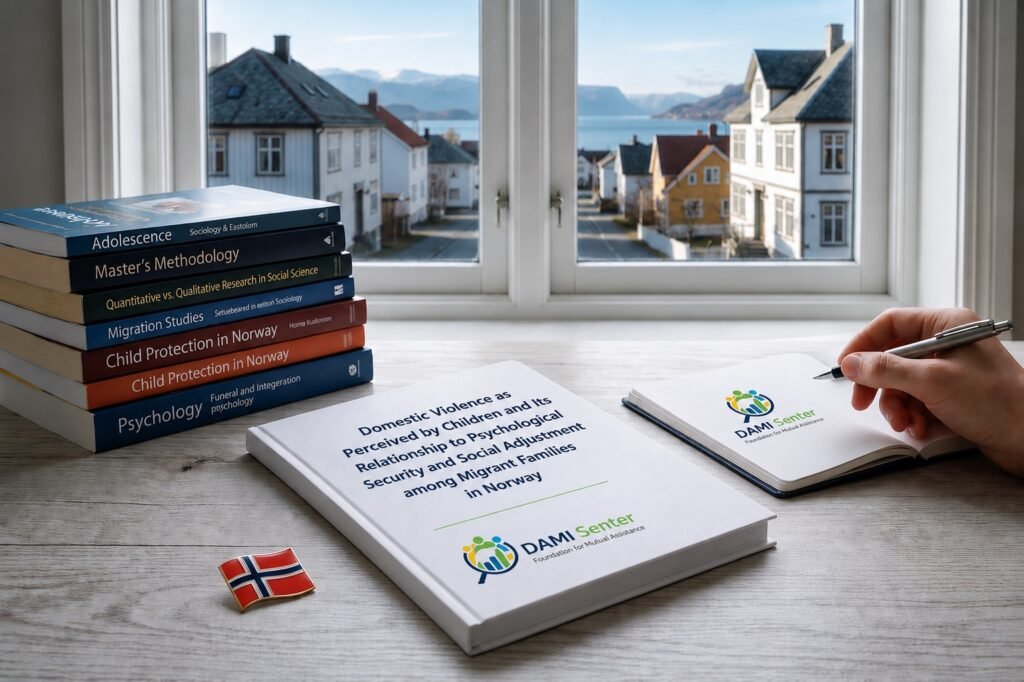
Research Summary
Domestic violence remains one of the most significant challenges affecting family stability and child well-being across different societies. Within migrant families, the issue can become even more complex due to cultural transitions, migration-related stress, social adaptation processes, and changing family dynamics.
This study examines the relationship between domestic violence as perceived by children and their levels of psychological security and social adjustment among migrant families living in Norway. The research is based on the understanding that children often perceive violence in broader ways than adults do. Their experiences may include not only physical aggression but also persistent family tension, emotional hostility, unspoken conflicts, and negative communication patterns between parents.
Using a descriptive-analytical approach, the study collected data through questionnaires administered to children from migrant family backgrounds. The objective was to explore how children perceive domestic violence and how these perceptions influence their sense of safety, emotional well-being, and ability to function socially within school and community settings.
Main Findings
The findings suggest that children’s perceptions of domestic violence extend beyond direct physical harm. Many children are highly sensitive to emotional tension, verbal conflicts, and unstable family environments, even when no physical violence occurs.
The study identified a clear negative relationship between perceived domestic violence and psychological security. Children who reported higher levels of exposure to family conflict and violence also reported lower levels of emotional safety and stability.
Furthermore, the results indicate that domestic violence negatively affects social adjustment. Children experiencing higher levels of family conflict often face greater difficulties in peer relationships, social participation, and integration within school environments.
The study also highlights the importance of cultural background and migration experiences in shaping how children interpret family interactions and understand violent behavior. These factors may influence both the perception of violence and its psychological consequences.
Research Implications
The findings contribute to a deeper understanding of how family environments influence children’s psychological and social development in migration contexts. They underline the importance of viewing domestic violence as a multidimensional phenomenon that includes psychological and relational aspects in addition to physical abuse.
The study further demonstrates the need for preventive strategies that strengthen family communication, support positive parenting practices, and promote children’s emotional well-being.
Recommendations
Based on the findings, the study recommends:
Developing support programs specifically tailored to migrant families.
Promoting positive communication skills within the family environment.
Increasing awareness of the psychological effects of indirect and non-physical forms of domestic violence.
Strengthening cooperation between schools, social services, and families to identify and support vulnerable children.
Expanding early intervention initiatives that enhance children’s psychological security and social integration.
Conclusion
Understanding domestic violence through children’s perspectives provides valuable insight into the hidden effects of family conflict. The study demonstrates that children’s experiences of violence are often broader than conventional definitions suggest and that these experiences have significant implications for their psychological security and social adjustment. Supporting healthy family relationships and strengthening early preventive measures remain essential for promoting child well-being and successful integration within diverse societies.
For access to the full research study, please contact DAMI Senter.
© 2026 DAMI Senter. All rights reserved. Reproduction or republication of this research summary, in whole or in part, is prohibited without prior written permission and proper attribution to the source. The views expressed in this publication are those of the author and do not necessarily reflect the official position of DAMI Senter.