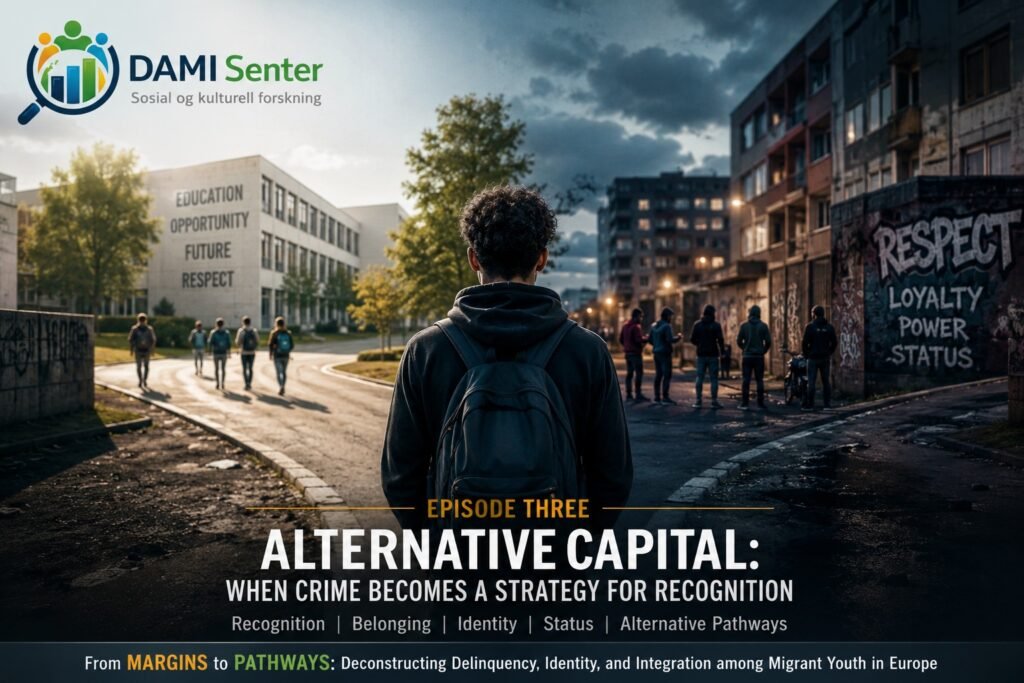
Alternative Capital: When Crime Becomes a Strategy for Recognition
From Margins to Pathways: Deconstructing Delinquency, Identity, and Integration among Migrant Youth in Europe
Season One: From Victim to Actor: Deconstructing the Myth of Absolute Innocence
Episode Three
By Louay AL-Daher – DAMI Senter
12.06.2026
Series Framework
This article is part of the analytical series From Margins to Pathways: Deconstructing Delinquency, Identity, and Integration among Migrant Youth in Europe. The series provides a structural and interactional deconstruction of the complex trajectories linking migration, identity formation, marginalization, and youth delinquency. Moving beyond reductionist explanations and polarized narratives, it examines how pathways of deviance and resilience emerge within contemporary European societies.
The Intellectual Paradox
Dominant narratives within media and traditional academic discourse consistently interpret youth delinquency as a spontaneous eruption of anger, frustration, or direct structural deprivation. Within these explanatory frameworks, adolescents involved in violence, criminal networks, and high-risk environments are often portrayed as passive individuals who gradually lose control over their actions under the weight of social and economic pressures.
Yet this interpretation encounters a critical question emerging directly from empirical reality:
If delinquency is merely a spontaneous breakdown of social regulation, why does it repeatedly manifest within vulnerable urban environments as a highly organized social behavior structured around rules, rewards, hierarchies, and symbolic identities?
Sociological reality points toward a different mechanism.
Early delinquency does not simply operate as social breakdown. Instead, it functions as a structured process through which individuals seek status and alternative forms of symbolic capital.
Human beings in contemporary marginal environments do not seek material security alone; they also seek symbolic recognition.
When conventional pathways toward upward mobility become structurally inaccessible or incapable of providing immediate social validation, criminal behavior emerges as a localized strategy for acquiring visibility, meaning, and social value.
Structural Analysis
Contemporary criminological sociology within Scandinavian contexts demonstrates that involvement in criminal environments is rarely driven exclusively by direct material gain.
Instead, behavior often reflects attempts to secure symbolic and social rewards operating outside conventional institutional structures.
Within this framework, the concept of Downward Assimilation serves as a central explanatory mechanism.
As institutional attachment weakens, certain groups of adolescents gradually move toward forms of reverse integration within deviant subcultures possessing their own internal structures and normative systems.
This structural trajectory aligns directly with findings from Ung i Oslo (2023), demonstrating that high-risk and violent behaviors increase alongside weakened Institutional Attachment to schools and reduced parental regulatory capacity.
Research by Hermansen (2023) further illustrates how Street Subculture (Gatekultur) within vulnerable residential environments can gradually transform into a parallel social market.
If institutions distribute recognition through education, long-term investment, and adherence to social norms, this alternative market reorganizes value according to a different hierarchy:
- Mutual fear becomes translated into local “respect”
- Violations of social norms become transformed into symbolic capital
- Violent identity becomes a mechanism for belonging and protection
Interactive Deconstruction
At this stage, the DAMI framework requires a direct challenge to the romanticization of victimhood.
Recognizing the human need for symbolic recognition must never become an ideological mechanism that transforms criminal behavior into an automatic or morally neutral response to structural pressures.
Young people growing up within similar urban environments frequently experience comparable structural constraints.
However, differences emerge through the management of Bounded Agency.
When an adolescent adopts street culture and aligns with deviant peer networks, the individual is not operating as a passive victim without awareness.
Rather, the individual exercises a constrained but active form of agency.
Within experiences of relative deprivation and limited opportunities, conventional educational pathways may appear demanding, uncertain, and incapable of generating immediate recognition.
Consequently, individuals may adopt a constrained but active strategy aimed at accelerating access to recognition and status.
Within DAMI sociology, delinquency therefore operates not merely as legal transgression, but as an alternative strategy for generating symbolic capital through an instrumental bypass of established pathways of social participation, the social contract, and the rule of law.
Conclusion and Policy Recommendations
The competitive advantage of deviant street subcultures does not primarily derive from geographical expansion or physical violence.
Their advantage lies in efficiency.
They frequently provide what bureaucratic and materially focused systems struggle to generate:
- Immediate recognition
- Accessible identity
- Visible status without long-term investment
- Strong experiences of belonging
However, the structural fragility of this parallel system remains equally evident.
Its symbolic value depends on the continuous reproduction of conflict, fear, and exclusion as mechanisms for sustaining its internal legitimacy.
The critical question proposed by DAMI therefore moves beyond asking:
“Why do young people choose crime?”
Instead, it asks:
How have institutional, educational, and preventive systems failed to provide stronger and more flexible pathways of symbolic recognition capable of competing with alternative markets of status?
DAMI Senter Policy Recommendations for Municipalities and Social Services
Dismantling Parallel Status Markets:
Municipalities should shift resources from passive material interventions toward structured educational and community initiatives capable of providing visible and immediate forms of institutional recognition.
Restoring Accountability within Institutional Spaces:
Educational and integration systems should reinforce behavioral expectations while ensuring that institutional support remains connected to civic responsibility and social participation.
Long-term mitigation of delinquency cannot be achieved solely through increasing expenditure on visible symptoms. It requires restoring stronger institutional pathways for meaning, identity, and recognition while anchoring them within the social contract and shared civic responsibility.
Next article:
Episode Four — The Academic Trap: Where Does Explanation End and Justification Begin?
© 2026 DAMI Senter. Alle rettigheter forbeholdt.
Denne artikkelen er skrevet av forfatteren, og synspunktene som kommer til uttrykk er forfatterens egne. De representerer ikke nødvendigvis DAMI Senter sine offisielle synspunkter.